Physical AI’s Opportunity Extends Beyond Hardware
Physical AI refers to systems that perceive, reason, and act in the physical world, taking in real-world sensor data, making decisions, and changing their environment, whether that's a robotic arm picking up a part or a drone adjusting its flight path. Physical AI has barely touched the largest sectors of the global economy, including manufacturing, logistics, construction, and the home, but the technology is finally capable enough to change that. Falling hardware costs and a maturing stack of compute, data, and models are making deployment economically viable at scale for the first time. This inflection point makes it one of the most attractive industries to generate venture returns over the next decade.
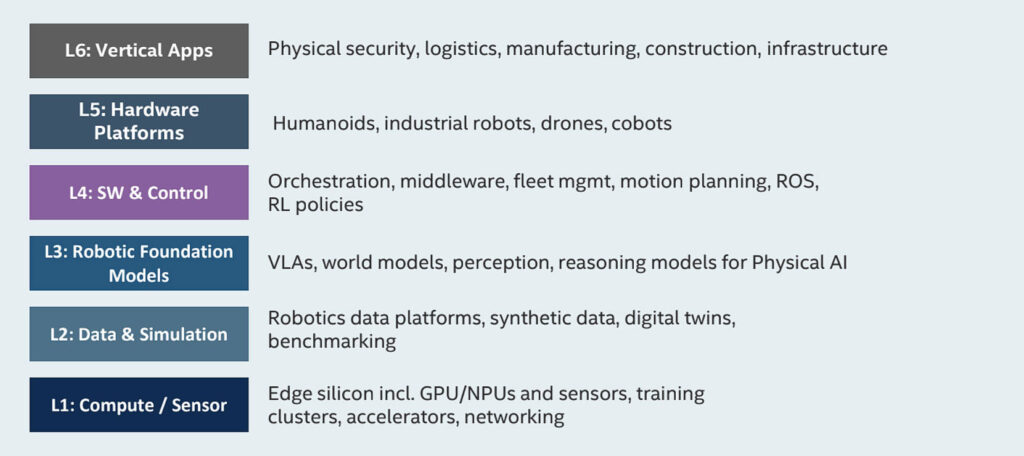
The industry is best understood as a general-purpose stack of compute, data, models, software, and hardware that lets machines operate intelligently in unstructured environments like factories, warehouses, and construction sites. As with cloud and AI software, each layer depends on the ones below it and has its own competitive dynamics.
- Compute & Sensor (L1): The foundation. Edge silicon, GPUs and NPUs, and the training clusters that make everything in subsequent layers possible. RealSense’s sensors and Lyte’s silicon contribute to this stack.
- Data, Simulation and Evaluation (L2): Synthetic data generation, digital twins, simulation, real-world evaluation and benchmarking infrastructure that train and validate robotic intelligence available via companies like Hugging Face and Twelve Labs.
- Robotic Foundation Models (L3): Vision-language-action (VLA) models, world and predictive models, and perception systems that enable machines to perceive, reason, predict and act in the physical world. FieldAI’s model, for example, develops models designed to operate across different robot embodiments.
- Software & Control (L4): Orchestration, fleet management, and frameworks, like Robot Operating System (ROS), that turn model outputs into coordinated action. Formant’s fleet spans 5 continents and powers some of the largest mobile robot fleets in the world.
- Hardware Platforms (L5): The physical bodies, like those made by Figure; humanoids, industrial robots, drones, and collaborative robots (cobots).
- Vertical Applications (L6): Where it all gets deployed into logistics, manufacturing, construction, and security. Beep is one of Intel Capital’s vertical applications, with its passenger mobility.
Why now?
Physical AI has been “the next big thing” for over a decade. What is different now is that progress is shifting beyond any single model architecture or scaling curve. VLAs remain important, but world and predictive models, simulation, reinforcement learning, and new post-training approaches are expanding the ways machines can learn about and interact with the physical world. As a result, model size or even the number of tasks and robot embodiments a model supports is no longer sufficient on its own as a proxy for progress.
At the same time, the data problem is becoming more nuanced. Robotics still needs diverse physical-world data, but the emerging question is not simply how to collect more of it. Different approaches increasingly combine human video, robot demonstrations, simulation, teleoperation, synthetic environments, and data generated during real-world deployment. The advantage may therefore shift toward systems that can determine which data improves performance, evaluate the result, and continuously feed failures and edge cases back into training.
This creates a second inflection point: the bottleneck is beginning to move from capability to reliability and deployment. Models are becoming capable of performing a broader range of tasks, but commercial value ultimately depends on whether those capabilities can survive in real environments, different hardware, changing conditions, and customer workflows.
The Funding Picture
Capital has taken notice of this shift. According to CB Insight’s State of Venture 2025 Physical AI venture funding hit roughly $40.7 billion in 2025, a 1.7x increase year-over-year, and early data from 2026 suggests the pace is holding or accelerating. Long-term total addressable market forecasts put the Physical AI market in the high hundreds of billions of dollars by the mid-2030s, a scale that, if realized, would justify the current investment surge many times over.
Despite this growth, the money isn't spread evenly across the stack. CB Insights Q2 2026 Venture Report that industrial humanoid robot developers and robot foundation model developers were the #1 and #2 AI markets by deal count in Q2 2026 by deal count, with 20 deals totaling $2.7B and 15 deals totaling $9.2B, respectively. The rankings highlight the growing momentum behind physical AI, with robotics attracting more deals than other major AI categories including coding agents, LLM developers, and cloud GPU infrastructure.
Where the Gaps Are
The next wave of opportunity may sit less in any single layer than in the infrastructure connecting them. Robotics still needs better data, but increasingly the challenge is determining which mix of real-world data, simulation, human video and deployment feedback improves performance, then evaluating those improvements in the physical world. This creates opportunities across data infrastructure, simulation, real-world evaluation and benchmarking, inference optimization, and deployment tooling. Companies that close the loop between data, models, evaluation and real-world performance may build more durable advantages than those focused purely on collecting more training data.
Ecosystem Forces to Watch
Data is one of the critical ecosystem forces that will shape how physical AI plays out over the next several years. While it is a scarce asset, the data sources that matter are multiplying. A new model-training stack is also emerging that blends real-world data, simulation and world models, and teleoperation, so the winners will be those who can combine many data sources rather than rely on any one.
Additionally, the market is split between generalist and specialist robots. Foundation-model companies are building general-purpose capabilities that work across multiple embodiments, while hyper-verticalized robots are built for a single function. It remains unclear which approach captures more value, and both will likely coexist.
Hardware costs are falling and commoditizing. As robot hardware gets cheaper and more interchangeable, differentiation shifts toward software, data, and deployment.
These forces play out against two broader backdrops. The US-China race is one: China leads in installed manufacturing robots, while the US and the West are leading in AI models and software. How the divide continues to evolve will shape global competitiveness. The other is the entry of Big Tech and incumbents. Cloud providers, chipmakers, and established industrial robotics firms are bringing distribution, capital, and manufacturing scale that pure-play startups lack.
Betting on the Middle Layers
Underneath all of this sits a bet that's worth stating plainly. Capital is surging into the space even though venture returns in robotics have historically underwhelmed. The wager of this cycle is that advances in models, data and training can finally break that pattern. But the enduring opportunity may not belong to any one layer of the stack. It may sit in the feedback loop connecting data, models, evaluation and deployment: systems that learn from real-world performance, identify failures, improve, and become more reliable with each deployment. Whether this cycle produces different venture outcomes will ultimately depend less on flashy demos and more on whether increasingly capable robots can become reliable, economical tools in real customer workflows.