AI in the Enterprise: How Companies Are Becoming AI-First
Across industries, the role of AI in the enterprise has evolved from experimentation to transformation. AI is no longer a discrete capability. For leading enterprises and those seeking a competitive edge, it has become a core part of how they operate, compete, and grow.
At Intel Capital, we see this evolution up close. As investors in the technologies enabling AI at scale, from infrastructure to applied solutions, we have a unique vantage point into how enterprises are re-architecting their systems, data, and teams to become truly AI-first.
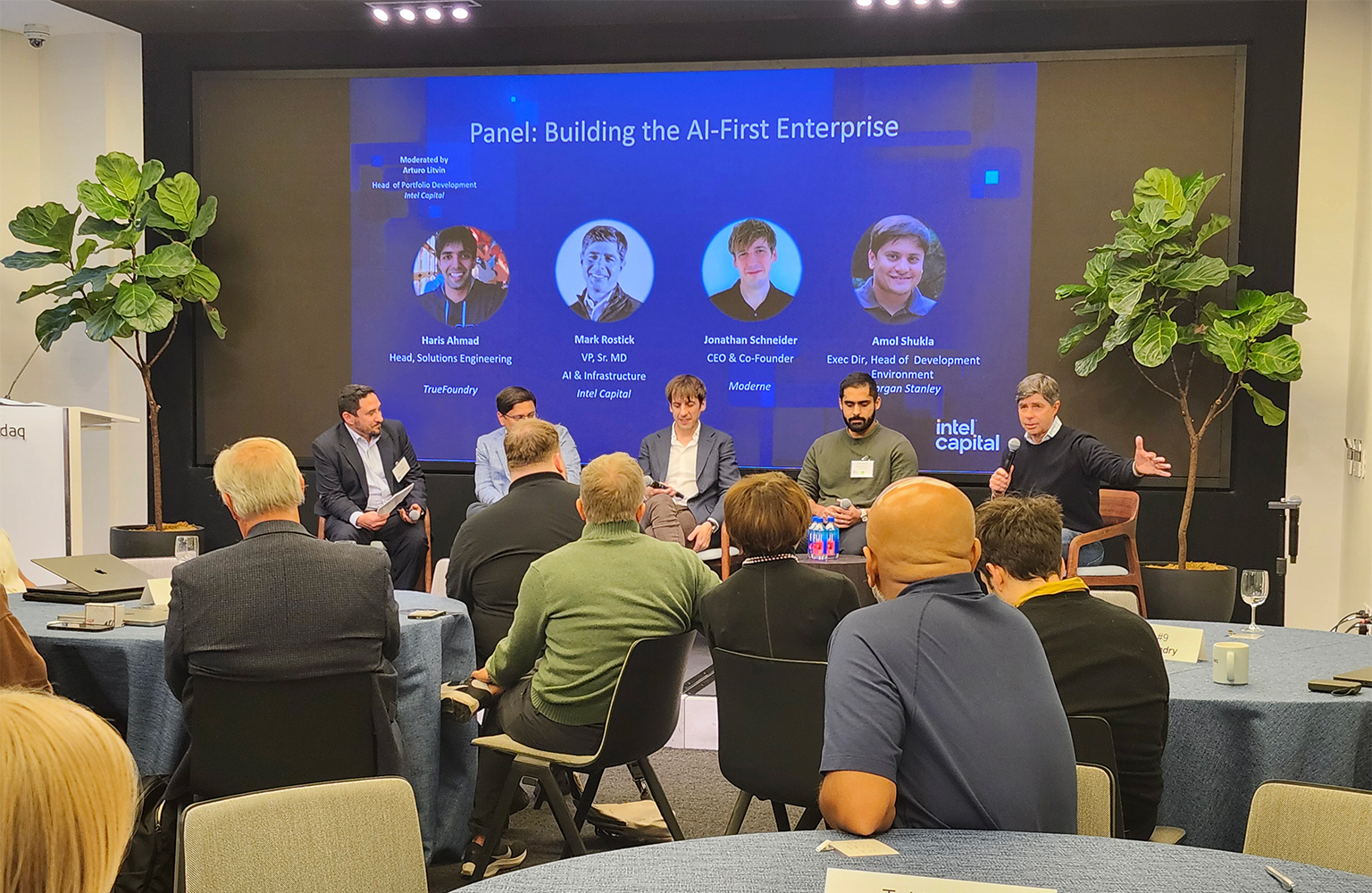
This past month, we continued our AI in the Enterprise event series, bringing together business leaders, founders, and investors to discuss practical ways to implement AI in business processes. The conversations underscored a powerful reality: AI is reshaping not only the tools enterprises use, but also the way they think, organize, and execute.
Insights From Enterprise Leaders
During our event, leaders from global enterprises shared how they are navigating the shift from AI experimentation to operationalization. The discussions centered on how organizations are:
- Aligning data strategies with business objectives
- Embedding AI into customer and employee experiences
- Measuring the ROI of AI transformation
A recurring theme throughout the day was that progress depends on coordination across people, data, and infrastructure, not any single technology choice. Enterprises that integrated these three dimensions holistically were seeing faster progress toward becoming AI-first. But the pace is not uniform.
Key Trends Defining AI in the Enterprise
- From Infrastructure to Intelligence. Enterprises are investing from silicon up, building optimized compute environments, scalable data pipelines, and development and operational platforms that make AI both more powerful and more efficient. Discussions during the event highlighted the growing use of AI to boost efficiency in application development, customer service, and sales operations.
- Data Readiness as the Differentiator. AI maturity continues to depend on data maturity. Many speakers emphasized that data quality, accessibility, and governance – not model choice – remain the greatest determinants of AI success. Enterprises that established unified and trustworthy data environments reported faster time to insight and stronger model performance.
- Responsible and Secure AI. As AI moves deeper into regulated industries, governance and security have taken center stage. Enterprise leaders shared how they are prioritizing explainability, traceability, and compliance frameworks to ensure that AI systems are not only performant but also trustworthy.
- AI-Enhanced Workflows. From copilots in productivity tools to AI-driven customer insights, enterprises have begun embedding intelligence into the fabric of their workflows. Attendees described this as a shift from automation to augmentation, where AI supports, rather than replaces, human decision-making. Still, organizations acknowledged that measuring the full impact of AI on efficiency remains a work in progress.
Looking Ahead: Predictions for 2026 and Beyond
- The Rise of the AI Operating Layer. The next wave of enterprise value will likely come from orchestration platforms that unify data, models, and business logic to create a cohesive AI operating layer across the enterprise.
- Hybrid and Open Ecosystems Will Win. Enterprises are demanding interoperability across cloud, on-prem, and edge environments. Leaders at the event reiterated the importance of open standards and flexible architectures that enable innovation without lock-in.
- Cultural Transformation Outpaces Technical Change. Becoming AI-first is as much a leadership challenge as a technological one. The most successful organizations are investing in upskilling, new governance structures, and agile operating models that allow teams to experiment, iterate, and scale quickly.
- Efficiency as a Competitive Advantage. As compute and energy demands rise, advancements in specialized chips, model compression, and distributed inference are redefining the economics of AI. Sustainable, cost-efficient AI is emerging as a core differentiator.
How Intel Capital Is Powering the AI-First Enterprise
Intel Capital continues to invest across the AI stack, from the hardware and software that power next-generation compute to the applications that enable enterprises to scale AI responsibly and securely.
Our portfolio includes companies advancing data management, model optimization, and AI-driven analytics, such as AI21, Asato, Bria, Immuta, LILT, MinIO, Scale AI, TrueFoundry, and Twelve Labs. Each helps enterprises translate potential into performance. Together, they represent a future where AI is not a side initiative, but an integral part of how businesses innovate.
For enterprises, becoming AI-first is not a single milestone. It is an ongoing evolution that blends technology, culture, and strategy. The organizations that thrive will be those that treat AI not just as a tool, but as a mindset for transformation.
As we look ahead, Intel Capital remains committed to supporting founders and enterprises building a future where AI drives meaningful, measurable impact across industries.